Unknown's avatar

About CrissyMoss

I've been writing as long as I can remember.

Of Gods and Goddesses

I once wrote an article about the origins of fantasy, namely mythology. It was many years ago, under a different name, still existing in cyber space somewhere, and it makes me cringe a little if I think about it. Not because my ideas were wrong, but because I, as a writer, have increased my skills so much in the last ten years or so that the old article just looks bad.

It’s a good reminder of where I was, and were I am, and hopefully a prelude of where I am going.

I loved mythology as a child. I couldn’t get enough of Greek and Roman gods causing wars, cheating, turning people to stone, and wrecking the world around them, or saving it at a whim.

There was the bittersweet love story of Psych and Eros. A woman who’s curiosity, and distrust, deprived her of the wonderful love given to her by a god.

There was the Trojan horse, and a war fought all in the name of love (or ownership) of the beautiful Helen of Troy.

There were the heroes, like Hercules, and Perseus, who braved mythical beasts and crossed entire continents to fulfill their quests.

In each of these stories we see the first structures of modern day tales. Romance, quests, revenge, war, suffering. Each an intrinsic part of the human narrative. Each a part of what has made our history.

When I wrote Forgotten Ones I attempted to pull on subtle hints of these gods, to capture their struggle with each other, and with the humanity which myth said they created.

That battle, in many ways, is real. Created from primordial pools of DNA, evolving into thinking, feeling, creative individuals, we still struggle against the world, the universe, that created us, and against one another. Massive natural disasters. Fires. Floods. Wars. Famines. The list goes on…

Struggle is what makes a book interesting. Overcoming adversity, and beating the odds. Whether it is a god, a goddess, or a human being.

And why shouldn’t the ancient myths reflect a very real struggle between man and the environment? Ancient men labored closer to, and had greater fear of, the wild places then we do in this day. They did not have guns to protect them, or metal sky scrapers to take them up above the wilds. They didn’t have planes, and satellites to tell them when the waters would rise, or crops fail.

But it’s a new age. The weather seems to be changing drastically with every turn of the clock. Tsunamis, fires, sinkholes, and even meteors pose real threats to people. So now we’re creating our own mythology in movies like “Dante’s Peak” and “Armageddon”. And it makes sense. Our myths are based on science, instead of gods, even if the science is faulty.

I think one of the reasons the old myths are so interesting is the human quality of a god or goddess. Maybe they are more powerful, invincible, and immortal, but they still love, and hate, and fight. They still have emotions. Something an equation, or a volcano can not do. You can reason with a god, or trick them. A volcano will blow no matter what you do, or what you promise.

So, yes, fantasy and story telling started with those great myths from the past. They started with fears, hopes, and dreams of men who came long before us. But we are continuing on in their fashion, fighting against the shadows in the night with words, and hope in the form of new stories, and new myths.
Letting Go.

Yesterday we drove an hour south of Portland. It was a very long drive, and a bit tiring. And when we got there we dropped off my daughter, and her bags. Then my boyfriend and I jumped back in the car, and drove home.

She’ll be at school for about a year, learning some life skills, and getting some certificates and diplomas so that she can get a job a little easier. She’s 18. She’s suppose to do this sort of thing.

But for me… my little girl just left, and my house is so quiet without her. My other two children don’t talk as much, or share their art and accomplishments with me quite as much as Tiffy did. They don’t complain that no one is doing chores, or constantly pester me to go get things for their cat.

Not that these things are bad. She is a really helpful person to have around the house, especially when I work a lot. But it made a constant noise in my house that is now gone.

I’m so proud of my daughter. She’s facing some of her fears so that she can make her own way. She’s a good example.

Now… I’m going to go toss and turn for a bit and fall asleep.

Why does net neutrality matter?

There are certain things a person, or any animal, needs to survive. Food, water, and shelter. A place to call home.

In the same respect, an economy, and a country, has things that it also needs to survive, and even thrive. Those things change over time as technology and the world evolves, but they are necessary just the same.

Before the invention of the telephone, people, and corporations, were limited in their ability to expand. They had to wait for correspondence through the mail, or short telegraphs. Or, travel, which at the time could take months to cross the ocean. Everything moved slower out of necessity.

After the invention of the telephone there was a period of adjustment. People understood the significance, but control of the phone and the lines involved, were regulated by one company, Bell. They, along with the help of the FCC, made it difficult to expand the network. Devices that were the precursors to faxes and modems were not allowed to be connected to the lines until the courts forced them to allow it. Bell wanted every device to be made and rented to consumers by them.

In 1974 the US Department of Justice filed an anti trust lawsuit against AT&T. It wasn’t until 1985 that they agreed to a settlement and broke up the monopoly.

They realized that the monopolistic tendency of Ma’Bell to suck every cent they could out of the industry was stiffling innovation, and technological advancement.

Now we have a similar situation. Companies and individuals depend on the internet for sales, marketing, communication, and entertainment. We get most of our content online. Indie creators have used services like KDP and youtube to promote and expand their reach.

All of this has been made possible because of “Net Neutrality”. Something a court ruling just overturned, and we no longer have.

Net Neutrality means that the internet provider is providing a service. Like a water company provides water. You can do whatever you want with the water, connect as many hoses as you like. Boil it, fill a pool. Freeze it and make an igloo. It doesn’t matter. You are just buying a service.

But internet providers are closely linked with cable companies, which means the increase of streaming services like Netflix and Hulu is a decrease in cable. Companies like Comcast and Verizon have been fighting for the right to charge users more to use these streaming services, thus making their $70 a month cable bill look more appealing.

This time it isn’t the FCC that is holding up the monopoly. It was a supreme court judge that said net neutrality wasn’t necessary because if you didn’t like your service you could just go to a different company. He failed to recognize the fact that many people do not have a choice in service providers, and even when they do the companies often work together to keep prices high. Only Google Fiber has given any real compatition

But don’t think this will stop with cable and netflix. Indie music, books, and cames also give competition to established corporations, and they will be looking for ways to use this to their advantage. What happens if youtube, or amazon get slowed down, or even blocked to make other publishers happy?

We simply don’t know how this is going to effect us, but one thing has always proven itself to be true: as long as monopolies hold onto the old ways innovation will be difficult, slow, or even non existent.

What can you do? Sign this petition. Spread the word. Send a letter to your congressmen, and the FCC. Email your representative. CALL THEM. Make some noise.

This is incredibly important. We are thriving because we have access to this marvelous technology. Don’t let them destroy it.

FAQ: I’m stuck, now what?

download“Writers Block” is often synonymous with “I’m stuck, what do I do?” It isn’t that you don’t want to write, or can’t write, it’s that you’re not sure what you should say, or how to say it. It is usually the “how” part that gets me to stumble. When that internal editor starts telling me my writing is terrible, and I need to do better. That nothing I write is going to be worth the effort, that is when I have to dig into my repository of tricks to get the words flowing again.

The first trick is to reread what you alread wrote. Not all of it, just the last couple of pages. eventually something might spark the flow and get you moving again.

If that fails, then you can use stream of thought writing. This is like “beats” (or rough outlining) but a bit more specific for the area you are working with.

An example from “Mermaids Curse”

the kraken is flailing about, and gets stabbed, and immediately flails more, grabbing acolyte’s and tossing them into the waters.

Koric is trying to reach his wife and daughter, but the tentacle falls in front of him, blocking his path, and two priests grab him from behind, thrusting him up against the skin of the kraken where he is covered in a layer of slime from the tentacle.

It isn’t the best writing. It probably won’t even be the finished plot, but it gives me a good idea of where I am heading, and when I come back to that little section I can rewrite it and polish it up.

First drafts are often messy and need to be stripped down to the good bits before sending to an editor, so this is your first draft. Keep going.

Another trick would be to start filling in the world building a bit more. Just write about the culture, the town, a person, or and event that happens near your story. It may not effect your story directly, or it could be the extra plot point you were missing.

And besides, you might use the little bits of world knowledge that don’t make it into the final product somewhere else. It may become a new plot point in future tales, or reference in this work. Don’t discount world building just because it doesn’t fit right now. In general, someone like Tolkien who had so much extra world building that he put it into a separate book of it’s own, writes fuller and richer worlds then someone with no world building at all.

Happy Writing

Who deserves the money?

A few days ago, Jim C Hines released his yearly statement on pay from traditional publishers. In response, Michael J Sullivan made this statement:

I really applaud Jim’s commitment with sharing income information. Back when I was unpublished I remember getting incredibly depressed after seeing his posts and the survey done by Tobias Buckell[1] about income and science fiction/fantasy writing.

I think it is important for people to understand just what the economic realities of this business are…

Nowadays I have a bit of a different perspective…I’m angry. Angry that someone like Jim could sell not one, not two, but three novels in a single year and still make, why I consider to be an incredibly small amount of money for the amount of work required to do so.

I’m angry he has to fit his writing around a day job. I’m angry that after 18 years and nine novels with one of the major imprints he’s made $33,598.19 last year and $60,800.

That’s just a part of what he had to say, and I admit, I agree with him. The major reason I don’t plan to go back to traditional publishing is the fact tat the royalties suck. A lot of the time you get an advancement, and never actually earn out for one reason or another, so you never get another dime. Plus you can’t go to Amazon, or B&N and see how many books you sold. You have no control over price, or sales. And if you want your rights back… well that’s not happening either.

But, I think placing all his anger on the publishing company is out of place.

How long have we had self publishing available? 70% royalties from Amazon, and we get to see everything. We have complete transparency, and ability to adjust everything the way we like. Not only that, but it’s been proven that you can make money that way. That you can gain fans, and become a best seller. That it is possible to do well, and that a hybrid model (publishing books in both traditional and self publishing) is the most effective way of getting your name out there, and getting paid.

And Mr. Hines doesn’t bother with self publishing.

To expect traditional publishing to change very quickly, after it’s been growing in momentum for the last few hundred years, is unreasonable. It’s like a train barreling down the tracks at high speed. It has a lot of weight behind it, and it is going to take a lot of force to stop it.

We, indie publishers, have added a lot of force to at least get them to change direction a little bit. They are bringing down some prices. They are starting to offer better deals to some of their writers, like letting them keep ebook rights. But it’s going to take a while to figure out the balance between traditional publishing and self publishing.

Ultimately, the power is in the hands of the authors. We can choose to go traditional, or we can choose to self publish. We have to weigh the cost and benefits for ourselves. Being angry at the traditional publishers for their lousy deals is like being mad at a train that won’t stop on a dime. They have only as much reason to change as we give them.

I’d also like to say we will probably be discussing this on The Self Publishing Round Table this Thursday at , so if you are looking for an interesting discussion of this, and other relevant topics, you should check that out this week.

My tongue doesn’t agree with my brain.

image

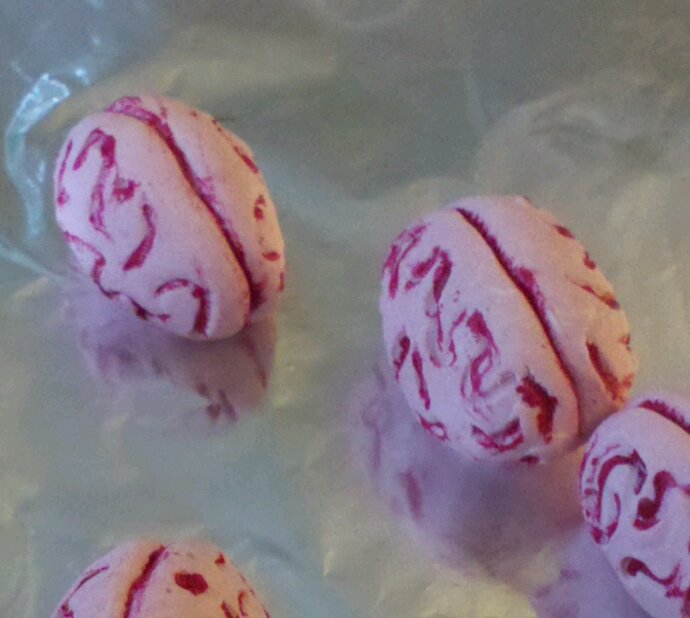
Zombie dice score markers I made.

I went to dinner with my boyfriend and his dad tonight. His dad is a lovely person. Smart, eloquent, well mannered. Incredibly well educated, and pays attention to minute details.

So when he started talking about muti-tasking, and learning I was happy. I did a lot of research in that subject because I found it fascinating. I had a lot of things to offer the conversation, and opinions and questions to share.

But somehow the connection between my brain and my tongue was disconnected.

I wanted to say: The research on muti-tasking is quite fascinating. It seems to all agree that we don’t do two things at once, rather we switch back and forth between the two tasks. However, I think most research has focused on two tasks needing to be completed at the same time. Not one task, and one passive skill (like listening to music). In the later instance you could be focusing most of your attention on the task at hand while your other senses are being distracted by the music. Say, for instance, like when I write a story. Most of my focus is on the words on the computer screen, and the music is drowning out any other distraction, including the distractions created by my own cerebelum when my mind wanders.

What came out?

Ya, the research is interesting. It all agrees you can’t do it.

Go me!

I even managed to sound like I thought learning piano was “just memorizing finger placement”. Cause my mouth was out of sink with my brain.

I ended up sitting in my corner of the booth chewing on steamed broccoli because I couldn’t bare sticking my foot in my mouth again. Some days I shouldn’t speak.

FAQ: How do I write?

image

We hear this all the time, and the answer from most writers is “sit down and write”. And that’s a valid answer, because in order to write you simply have to pick up a pen, or type on a keyboard, and write.

But I think the question most people mean to ask is really “how do I keep writing, even when I don’t want to?”

That’s a little more complicated. Learning to write is, in many ways, as hard as learning to play an instrument or becoming a pro-ball player. It’s less physical (unless you count carpel tunnel from all this typing) but it takes practice and dedication.

The other question might be: “How do I stay inspired?”

There is a terrible myth that all great art is created by this magical muse that comes and gives you incite at the right moment. Then you write a LOT, and everything is wonderful. It’s bullshit, but that’s the rumor.

The truth, and a truth all failed artists of any medium fail to see, is that the really great artists (Michelangelo, Da Vinci, Picasso, Van Gogh) had a few hundred paintings and sculptures in museums. Thousands more of their paintings were destroyed before they ever left the studio because they simply weren’t good enough. There are whole sketchbooks from some of the greats of pictures that were started, restarted, scratched out, and restarted again.

Ray Bradbury wrote a short story every day for YEARS. Not all of them were great, but he had a lot of practice, and a lot of them were. Picasso painted several paintings each day, and only a handful survived.

You need to write, and you need to write A LOT in order to get better. Thinking you can get out of that disregards all of the years that every other artist has ever put into writing.

As for the muse… create your own muse. Find out what inspires you to write, and keep doing that. For me it’s reading good books, talking to other authors about writing, or listening to a podcast. I know that if I do these things a lot then I will probably produce a lot more words on the page, just because I want to keep going. I want to see my book finished and in print.

For you it might be long walks, a shower, or a contemplative morning in front of a tech magazine.

Find what works for you, and keep doing that. Make your own muse. And even if the muse doesn’t come, sit down and write about the muse. Ask her/him why he isn’t showing up, and keep going.


FAQ : Are Zombies Overdone

In a forum this morning, a fellow writer said they came up with an idea, and thought of setting it in a zombie apocalypse. They wanted to know if zombies were overdone.

My Response:

Zombies are a bit over done at the moment, but they go in and out of style just like witches, vampires, and werewolves. I believe “witches” are the current hot thing, or so I keep hearing.

The thing is, you should write what you love, because that love will shine through. So what if the market has too many zombie stories. Your first job is to write, worry about markets later.

Second, if you could take the zombies out and replace them with anything else and still have the same story, then really it isn’t going to matter. People will come for the story, not just the monster of the day.

Lastly, Even if they are over done, there will always be people who love them. Write it, publish it, and it might find a small audience now, and a larger one later when zombies become the “thing” again.

But really, just write what you love.

A Challenge and a Review

millwords

A Challenge

A group of my fellow authors started a little challenge for the new year. The challenge is to be the first to write a million words for the year. Not just on books we might be writing, but also including things like blog posts, notes for world building, articles, or anything else we “write”, because ultimately writing is all about putting words on a page.

I am skeptical that I can do this. Sort of.

I write a lot each day. I write a bit on some stories. I do blog posts. I answer emails, and talk in forums about odd things I find on Reddit. But I can’t bring myself to “count” those words.

I suppose, if I wanted to, I could cut and past all those little snippits of words from conversations about the political climate in Washington, and weather or not the cute little otter running back and forth across the fence is really THAT cute, and shove them into a file marked “BLAH” and count them. But that feels like cheating to me.

And it isn’t that I’d be cheating the challenge, because the challenge specifically says “ANYTHING” I write counts. It’s that I feel I would be cheating myself.

Last year I wrote about a quarter of a million words, only including actually work on books and short stories, or blog posts. That also included a few ideas for future stories, but it didn’t count all the blog posts I started and never finished, or those I eventually threw out as a bad idea. It didn’t count several thousand words I threw away as something that would never come to fruitfulness. Maybe those things would be interesting to see.

I wanted to work myself up to 1000 words of story a day anyway, and that would get me close to 400k all alone, so perhaps with all this other writing added in I will get closer to a million. But I refuse to count posts on Reddit, Twitter, Goodreads, and other social media. THAT is where I draw the line.

A Review

FO-smSimon Canton was nice enough to do a review over on his blog for “Forgotten Ones”. It was a fair review, and…

Well, I don’t generally make it a point to answer reviews, or comment on them for various reasons, but I will say that I do have two more books planned for the “Eternal Tapestry” story-line. One will be a revisit of the “Necropolis” short story, and go back to the first time Jadina meets Maylin. The other is a story that comes after “Forgotten Ones”, dealing with another goddess that managed to survive the modern age. Because I agree with Simon that it would be much better as a full novel. So,… I’m working on that.

I find it incredibly interesting that so many people read my stories and their first comment is “I wish this was longer, I wanted to read more.” Which just leads me to think that I really, REALLY need to put out some novels so I can give people what they are asking for.

I’m working on it!

Some Updates

“Mermaids Curse”, my NaNoWriMo project, is now at 48k. It’s about half finished, maybe a little more. It also has a LOT more action then most of my books, and maybe a couple sex scenes just because they seemed to fit at the time. (That is, if I can write them. I’m still not that confident in writing a full fledged sex scene.)

That is my big project at the moment, but in between filling out those chapters I will continue writing short stories simply because I love finishing stories, and I love publishing things so people can read them. Since it takes me such a long time to finish a novel it just makes sense that I’d do a couple short stories a month too.

“Footprints” is finished, but I won’t be putting that out for a little while. Garrett Robinson is working on an anthology, and “Footprints” will, hopefully, be part of that. I am not sure if I want to put it up as a single before or after the anthology is released.

“Zombie Swarm” is the current short story I am working on. It is my first (and probably only) zombie story, and looks like it will be 5-8,000 words. It is a rather unique view of zombies, and I really can’t say anything other then that till it is released. Which, I hope, will be by the end of this month.

Podcasts Galore!

So, if you haven’t noticed, I am now a full fledged member of Story Telling Podcast. I’ve already made my debut episode here. It was pretty great. We talked about, and maybe argued a little, about what makes a writer a writer, and the difference between author and writer. And a few other things.

We also had another episode of Self Publishing Round Table.

Also, Story Telling Podcast will now be on Monday nights every week, unless the sky falls.


A list of great podcasts you should watch or listen to:

Self Publishing Podcast (Better Off Undead is there too)

Story Telling Podcast

Self Publishing Round Table

Buddy’s Writing Show

Siege Perilous Podcast (book reviews)

Books and Beer