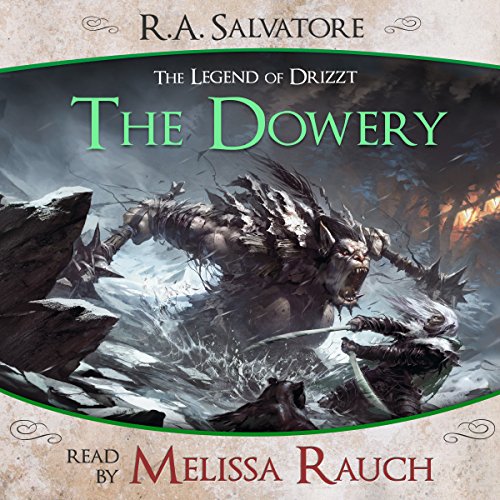
I’ve read a lot of R.A. Salvatore. Wulfgar, Drizzt, and Catti-brie, with their adventures across Icewind Dale. So when Audible had a bunch of short stories from the Drizzt series available for free, of course I grabbed them up. I’ve been listening my way through.
Version 1.0.0
Some are interesting. Some are explanations of things from older books. A few only slightly connected.
In this particular story we find Drizzt and Catti-brie trying to capture or kill some pirates in order to pay their way onto a ship… or to at least prove themselves worthy of being aboard it.
What strikes me, listening to it, is the flow of the words, and seeing how language has changed over time. Newer fantasy might still give you that thick description of places, themes, and experiences. But Dowry isn’t just thick with description. It uses a style of writing that almost feels archaic compared to modern fantasy.
And that’s normal, of course. Language shifts over time. We no longer speak Old English. Even language from back in the 1950s would feel different from someone speaking today. We don’t say “rad” or “square” or half the old slang anymore. And slang of today is constantly shifting. (Who the hell knows what “6-7” means anyway?)
But for this particular story, it’s the wordage itself. It’s the way it flows, the structure of the language, the way each sentence is built. That’s what gives it the old-time feel.
This isn’t to say it’s bad. In fact, I’d argue that if you’re trying to write a story in that kind of setting, you’d want to lean on older style and slang in your prose to keep the feeling consistent across the board. But it’s also wise to keep in mind that the same style that builds atmosphere for one reader is the thing that bounces another one right out of the book. Choosing, and sticking to, a style that draws in the audience you’re looking for is an important part of creating your own voice in writing.
The opposite end of this is that modern slang tends to go out of popular circulation pretty quickly. Using too much of it might make your work look dated sooner. There is also the option to make your own slang, like Pern by Anne McCaffery using “shells” as a swear word since the whole world revolved around dragons.
The trick is to keep your reader in mind, and wright for that person. Because you can’t please everyone, but you can try to please the one person you’re writing for.
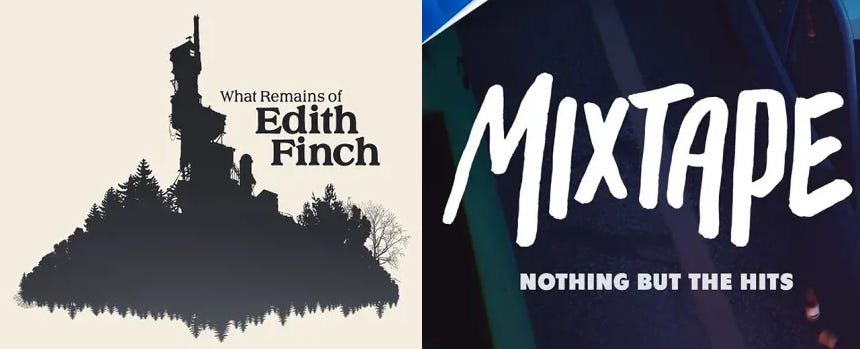
If you follow gaming news you might have heard of Mixtape. Asmongold and a number of other big streamers and critics have been talking about it for the last month, and not in the way the publisher was hoping.
Mixtape is a walking sim (on a skateboard) that puts music front and center. That’s not an unusual style of game. Dear Esther, What Remains of Edith Finch, and Gone Home are all well-received games in roughly that family: titles that emphasize narrative and atmosphere over traditional mechanics, while still sitting right in the middle of the long argument over what counts as a “game” at all.
And here’s the thing those earlier games proved: a good experience will be well received even if it doesn’t lean on traditional gameplay. Edith Finch is, by most honest accounts, more of an experience than a game. And it’s beloved. It sits in the top couple of percent of games critics have ever scored, and players rate it even higher than the critics did. Dear Esther is barely interactive at all, a quiet meditative wander, and it found its audience too. Nobody needed these games to have combat or puzzles or a score counter. People just needed them to be good, and to deliver on what they promised.
So what happened with Mixtape?
To answer that, it helps to look at what actually captivated people in the games that worked.
What Remains of Edith Finch is a collection of short stories about a family that cannot seem to stop dying. You move through the old family house and live out the final moment of each relative, every one told in a different style. The house is melancholy and strange. Each story has you wondering if your reliving a truth, or a fantasy. The atmosphere makes a promise and the story keeps it.
The game makes a promise from the beginning of an interesting (and beautifully told) story. And the game keeps the promise. The players trust in the game held, and their enthusiasm was earned.
Gone Home is where it gets interesting, because it’s a good game that slightly missed its own mark. You come home to an empty house and slowly uncover what happened to your family by poking through their things. The atmosphere is genuinely unsettling. A dark, quiet house, a thunderstorm, odd details, even a pentagram in one room. It builds and builds toward what feels like a tragedy hiding behind the next door. You brace for something terrible behind it.
And then the answer is gentle. Your sister fell in love and ran away with her girlfriend. The parents went after her. That’s it.
There’s nothing wrong with a tender ending. The problem is that the house spent two hours telling you a ghost story while the plot was telling you a love story. The two never quite reconciled. The well told craft dread landed flat.
Gone Home got perfect scores from several major outlets, but its player reception was much more mixed, with a good chunk of that gap being honest disappointment at the disconnect.
Which brings us back to Mixtape, and to the difference between a game that slightly misjudged its tone, and a game that arrived wrapped in a sales pitch.
Mixtape didn’t show up quietly and let people discover it. It showed up with a banner of perfect scores. Its store page proudly displays a row of 10/10s from various review sites. And here’s the counterintuitive truth that publisher after publisher keeps relearning the hard way: a wall of perfect scores doesn’t make people trust a game more. It makes them trust it *less*. A genuine masterpiece doesn’t need twenty critics swearing it’s flawless. The banner itself reads less like “this is great” and more like “someone needs you to believe this is great.” The bigger the manufactured signal, the louder the alarm bell.
So the perfect scores did the opposite of their job. They drew exactly the audience most allergic to manufactured hype. Streamers, like Asmongold, who treat unanimous praise as a dare. The marketing summoned the people most likely to take the game apart.
And then the game itself confirmed the suspicion. Mixtape plays itself, more or less. It’s a skateboarding game where, if you hit a car, it just rewinds and gives you another shot. Sometimes you simply roll over or around obstacles without touching the controller at all. The common complaint is blunt: you don’t play this game, you experience it.
And worse, it sold itself as an indie game while having big money behind it. Enough money to pay for licenses for major songs in perpetuity.
That phrase is worth sitting with, because it’s the same phrase people use lovingly about Edith Finch and Dear Esther. “It’s more of an experience than a game” is a compliment there. For Mixtape, the identical words are an insult. The only thing that changed is trust. When you trust that the people praising a thing are being honest, “it’s an experience” means “let the craft wash over you.” When you suspect you’re being sold something, “it’s an experience” means “there’s nothing here and they’re hoping you won’t notice.”
That’s the whole lesson, really. Edith Finch and Dear Esther show that earned praise builds trust and lasting affection, even for games that barely qualify as games. Gone Home shows what happens when the experience runs a little behind the promise. A gap opens, and people fall into it. And Mixtape shows what happens when you try to manufacture the praise instead of earning it: the propping doesn’t protect the product, it becomes the very thing people punish.
You can buy the licenses. You can buy the scores. You can buy the banner. What you cannot buy is the thing that actually mattered all along: a player who finishes your game and trusts that the good thing they felt was their own.
Last night we took a chance on Beetlejuice 2. Both my significant other and I had grown up watching the movie, and the cartoon for Beetlejuice, so of course we were interested in a new feature film. However, knowing films these days, we went in with low expectations so that we couldn’t be disappointed.
Did we like it? Well…. it was… okay.
And I suppose that is the best we could expect from some films these days. Okay. It didn’t have any terrible plot elements, it didn’t reference modern society, or make commentary on politics. It was just a film about a mom and her daughter in a world full of ghosts.
But it wasn’t great either. The film felt like it had three plotlines running through it, and the plotlines were at odds with each other instead of complimenting each other. The advertisements all were so keen on Beetlejuice’s ex-wife, but she was only in about five minutes of the movie so when it came to the conclusion it felt… hallow and forced.
The plot around Lydia and her daughter, Astrid, was far more interesting, and had more chances for hijinks. Instead it felt like it was cut short in favor of showcasing the waiting room with all the weirdly dead people in it over and over again, or having brief scenes with the actor turned police chief ghost played by William Defoe.
It had good elements, funny scenes, interesting background characters that dressed the scenes nicely… it just didn’t have a full plotline that felt really satisfying. So it ended up being… okay. Not great, not horrible, just… okay.
So if you just want to get out for a night and spend some time at the theater, it’s okay.
Book read: Breath for Me by Edward Robertson. Pages: 17
When I downloaded “Breath for Me” onto my kindle I wasn’t sure exactly what to expect. I didn’t remember picking up the book, and the cover just had some palm trees and simple text across the front. (Though it does say “fantasy story” in very small cursive letters that I didn’t notice until writing this.)
What could a photo of palm trees in green and red tones be? I thought a literary fiction work, or just a fiction story set in a tropical location. Either way I wasn’t expecting a group of slaves building an aqueduct in the middle of a jungle. And I certainly wasn’t expecting the main character to have the ability to make illusions with his magic breath.
Setting the cover aside, I was interested in the setting. I haven’t read many books from a similar time period, so I continued on with the read.
The plot is simple. A man is working to build an aqueduct as a slave (perhaps an indentured servant as it is only for a specific amount of time). He starts sharing stories at night using his illusions to create plays for the other slaves. The overseer, wanting to wave around his authority because he hates his job, tells the main character to stop. MC warns him that a riot will break out, but complies. A riot breaks out and several people die. Then…everything gets confusing.
Before I continue I am going to admit that I am in the minority, it appears. Reading this work, I was incredibly confused at several points in the story. I re-read the ending three times and I still don’t know what exactly happened. The reviews seem to be more favorable. Some of this is clearly because the readers are familiar with Mr. Robertson’s work as they make reference to his other stories. But there are others who found it confusing, as I did.
I, as a new reader, do not have any idea how the magic in this world works. He breaths, and through his breath he can make illusions appear. I don’t know the limits, but the other slaves seem to imply the magic user should be able to build the aqueduct with a wave of his hand. Only the MC insists he isn’t a good magic user and the illusions are the best he can do.
So when mountain sized men in chains start across the sky…I was confused. I think the MC is showing everyone what happened, and how one of the slaves was killed, so that the other slaves would rally together and fight back against those in charge. But everything happens incredibly fast, with broken thoughts strung together, so it’s hard to follow. That, coupled with the fact that I’m unfamiliar with this writer, or his worlds, made the experience a confusing one.
So what did I learn from this short story? First, know your audience. Not only the audience you already have, but are you trying to reach new people with this story as well? Will someone who has never read your work understand what’s going on?
Second, less is not always more. This story was only 17 pages long but I think if the last two pages had been given a few more pages to grow it might have been less confusing. It would also have separated the epilogue from the main story a bit so that it felt like a distinct part instead of just a run on from the previous paragraph. In writing you have nothing to show the passage of time but your words, so use them.
And lastly…not everyone is going to like your work. There are plenty of people who like this story and give it five stars on amazon and goodreads. I won’t be one of them. I think I’d give it a three. That doesn’t mean the story isn’t good, it just means that it isn’t for me. This is important to keep in mind as a writer. You can not please everyone, no matter how hard you try. But also keep in mind if everyone is complaining about the same thing then you probably do need to reevaluate what you’re writing.
And sometimes the stories we like the least are the ones we can learn the most from.
Next story: Zombie 69 by Kitty Glitter (um… this should be interesting…)
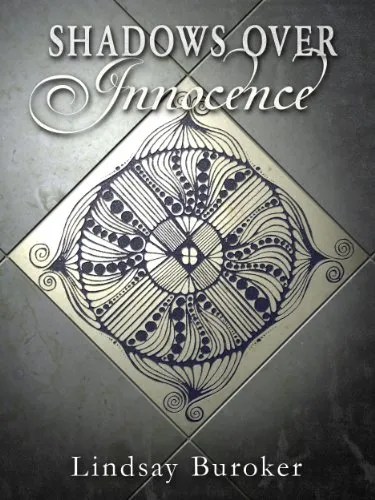
This weeks story is a short, but sweet, tale of an assassin watching over a the young heir to a kingdom. There is no softness, no joy in this assassin. All emotion has been beat out of him by the emperor that rules with an iron fist. But still…there’s something about the innocence of this young buy that gives the hardened assassin pause.
Overall the story was an enjoyable peak into this world that the author created. It’s hard, and viscous. It is a land where might makes right. But even in this world of hardness and pain there is one small point of light flickering in the darkness.
But even in a lovely tale like this we, as writers, can learn something.
For this story it was the naming convention. Lindsay Buroker went with names that were unusual, each with three to four syllables, and each unique enough that they might give some readers pause. Still, in fantasy worlds that isn’t unusual.
However, the main character and the heir have names that are very similar to each other. Sicarius and Sespian. This isn’t a hard and fast rule, of course, but one naming convention for story telling is to give characters distinct names so that they don’t get confused, and specifically starting with a different first letter.
While reading this particular story you are first introduced to Sespian, the assassin. He happens across Sicarius within few paragraphs. It is clear they are two separate people, of course, but in my head I kept getting the names mixed up as I was reading it. I had to take a minute to actively separate the two so that I could tell which was which. On the other hand the other named characters, Hallowcrest and Raumesys, had distinct names that were easy to keep straight.
While reading many of us do not take in the words syllable by syllable. We take them in as a whole. Maybe you have seen this puzzle floating about the internet:
Aoccdrnig to a rscheearch at Cmabrigde Uinervtisy, it deosn’t mttaer in waht oredr the ltteers in a wrod are, the olny iprmoetnt tihng is taht the frist and lsat ltteer be at the rghit pclae. The rset can be a toatl mses and you can sitll raed it wouthit porbelm. Tihs is bcuseae the huamn mnid deos not raed ervey lteter by istlef, but the wrod as a wlohe.
Most fluent English readers can decipher this fairly quickly. That is because we take in the words as a whole unit and our mind automatically translates it into the proper spelling. There is a little more to it, you can read more about that here, but in general if the first and last letters are correct than it is easy enough to get the gist of what is said.
Which brings us back to the two names with the same first letter. If you are taking in the name as a whole, not as individual syllables, it is easier to get them mixed up. Separating them with different beginning letters, especially when they appear quite close to each other in the text, helps to separate out the characters.
Such a simple thing, and yet it makes a big difference in writing.
What is one of the first things they taught you in English class? Or one of the lessons that stuck with you? For me it was always, ALWAYS, “Show! Don’t tell.” It was drilled into my young mind from the moment I could hold a pen. Show the story, show the characters and the interactions, don’t just tell it to me.
Picture this: A dark trail, branches reaching high above, their naked fingers scratching at the velvet black sky. A lone figure stumbles down the path clutching at his leg, hot blood seeping from a wound. With heaving breaths, he sends quick glances back over his shoulder, but there’s nothing there.
Can you picture that? Can you feel his heart thumping, the fear in him as he tries to staunch the wound, the desperation as he searches the darkness?
Or I could say, “A dude walks down a dark path with someone chasing behind him. He has a wound on his leg that’s bleeding.”
Which would you prefer to read? Which would keep you entertained?
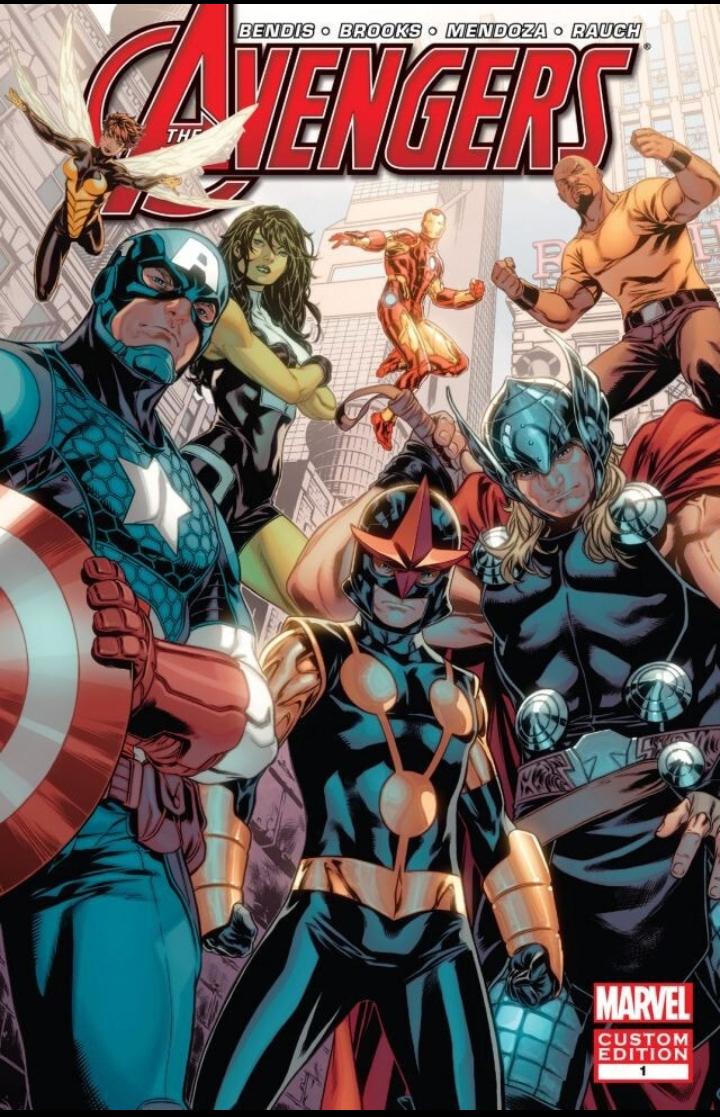
The idea of “show don’t tell” is a hard lesson to learn, and I think one many writers never learn. I believe this even more after reading this week’s short story, or rather a comic. Avengers: Heroes Welcome does so much telling, and zero showing. So much that it felt more like a sermon than a story.
First I will say, I really do love comic books. I’ve been reading and collecting them for decades now. My favorite has to be Escape from Wonderland, with Fable as a close second. But I also had quite a few Avengers, Thor, and Spider-Man back in the day. So I’m not unfamiliar with how comics use panels, and short page counts, to get a story across.
A comic is an illustrated short story. It uses art, as well as dialog and limited narration, to show the action. Most comics (back in the day) had high action content. Catch the bad guy, or escape the serial killer, that sort of thing. But a good comic could get the story across between the pictures and dialog, with very little narration.
“Heroes Welcome,” on the other hand, has no action. No real story, just a bunch of people sitting around discussing what makes a hero.
This feels like the author wanted to tell people what they thought a hero was, and instead of writing a story to show a hero’s actions, they had Nova (a young hero I’ve honestly never heard of) barge into the Avengers headquarters and start asking philosophical questions about what makes a hero.
Don’t get me wrong, it isn’t the first time a superhero had a case of conscience and needed to figure out if they were doing the right thing. Spider-Man goes through this frequently since his actions often cause the bad thing to happen, and his story revolves around taking responsibility for your abilities. But his questioning always happens while in the midst of action, and his actions or successes lead him to his answers.
Instead “Heroes Welcome” is literally just a bunch of people sitting around a room talking.
I was disappointed. The plight of the hero, and what is a hero, is the very substance of a superhero story. And yet they stripped away all vestiges of that to make it a boring classroom lecture.
And sadly they had the perfect opportunity to show exactly what a hero is. A rescue from a fire, and a heart touched. A single life saved, going on to be changed from then on.
This is something firefighters and police officers do daily. They could have used that example to show heroism, even in the face of a person who has no powers.
Back when I started collecting Kindle books, I gathered a number from newer authors I hadn’t heard of. I would hear about them from a daily deal or a friend on Goodreads and add them to my collection, often because they were short reads marked free to encourage you to get the second in the series.
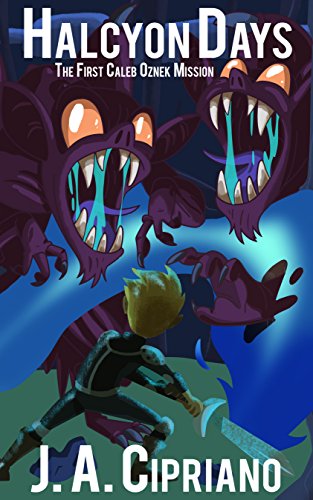
Halcyon Days seems to be a free giveaway to introduce others to a series. I say “seems to be” because it is no longer available on Amazon. Mr. Cipriano has a large list of books to his name since then, but this appears to be an abandoned series.
Considering many people think prologues are a forgotten relic, the idea of a short story prequel to a series has appeal. It could introduce people to the world, help others find the series, or give those who want more information something to sink their teeth into. Setting it up for 99 cents with the occasional free giveaway also gives readers a chance to try your writing.
Free books don’t have the same punch they used to. Amazon changed a lot of algorithms, as did every other book site, which changed how writers engage with readers. That doesn’t mean the free giveaway is completely useless, just that it isn’t lightning in a bottle like it once was.
One big problem with free giveaways happens to be the reader like me, the one who collects a bunch of new stories and doesn’t read them nearly as fast as she collects them. Still, with the hope that some of those who pick up the free copy will actually read it, enjoy it, and come back for more… we authors give away a lot of copies. It’s like sending a message in a bottle out to sea. So many get sent out, but only a few ever find another soul to connect with. That small glimmer of hope, that dream, it’s the reason so many bottles get sent out with notes to begin with.
As for Halcyon Days, it was a solid contender to get someone interested in a series. A boy is rescued from the monster under his bed and taken to a world of magic. He’s then introduced to a magical society that hunts the evils that go bump in the night, like vampires, hopping from one world to another in order to do so.
The idea left a lot of room for growth. Do you follow the lone earthling? Pick one of the alien hunters? Take the earthling to a new world? Such an open-ended premise could give a writer issues unless they had a specific destination in mind. That could be why this was abandoned, or it could be as simple as another series taking off and wanting to limit which projects he put his efforts into.
We shall never know what became of Halcyon Days, but I might pick up his book “Alone in the Dark” just because it seems… interesting.
This short story has been on my kindle for over five years now. I picked it up when it first came out because I had been on a podcast with Miss Coll, and I wanted to support her work. I never got around to reading it, and I’m not sure why. I don’t really have an excuse, it’s only 13 pages, and took me less than thirty minutes to read.
The Miscellaneous Adventures of Princess Leona is a Grimms style fairy tale about a princess of extraordinarily ordinary origins trying to become a witches apprentice. It has a lot of forth wall breaking by the author, and a narrative style that I found charming.
This was written back in 2013 during a time when “episodic” story telling was all the rage. Miss Coll, along with myself, followed the Self Publishing Podcast which was a group of three guys that talked a lot about the episodic story telling model, so it isn’t unusual that many of us tried this tactic.
An episodic tale is one in which there are multiple shorter stories that are published separately, and together they create and entire season for that world. The SPP guys were influenced by film. Think Breaking Bad, Star Trek, or Friends. Each individual episode had a complete story involved, but they all progressed character development, and the over arching plot of the main series.
Many novel series does the same thing. Xanth, DragonLance, Vampire Diaries, Jack Reacher, etc. Each book in the series has a distinct story of its own, but it contributes to the overall progression of the series as well.
The main difference between a traditional book, and the episodic tellings of the SPP theory, is that the stories were shorter. A traditional book was about four times longer than the SPP episodes. They also sold them for $2.99, then bundled the full season for $5.99 when they completed the season.
For them, and many others, it worked. But there was one flaw that happened with many stories. That is the sudden cliffhanger, or the incomplete story.
Princess Leona’s story falls into this latter category. While charming, I did not feel like it had a satisfying ending. There was some progress toward the end goal, but the narrator kept insisting the end did not exist, there was no edge of the forest. And while there were a couple of encounters with dubious fellows, it felt more like building a team than overcoming an obstacle.
This is the trouble of episodic storytelling. You can, and probably should, have a cliffhanger ending, but you need to have a satisfying ending as well. When completing a book something should have been accomplished, even if it isn’t the final ending. Without that satisfaction of a job well done…well I feel like I’ve just wasted my time.
The other tangle in this weave is that there are only two stories out by Miss Coll, and because the second is just as short as the first I don’t feel an inclination to buy and read the second one. After all this time I doubt she will add a third, and I do not know if the second story will have a satisfactory ending to it. If it were to be another cliffhanger with no further reading then it would be even more disheartening.
In conclusion…Episodic storytelling may not be as fashionable as it once was, but it is still a viable story telling device. However, each story in the series needs to feel like a complete tale that is worth the readers time in reading, with just enough of a hint of the next book to keep them going forward. Otherwise you risk alienating your reader.
And that is what I’ve learned from the first book. Stay tuned for the next: Halcyon Days by J.A. Cipriano.
A tale as old as time. Boy meets girl. Boy looses girl. Boy gets sealed into a brass jar for two thousand years. Okay, maybe not the usual story, but definitely an interesting one.
In 3000 Years of Longing a literary analyst finds an old glass bottle. The cap falls off while she (Alithea, played by Tilda Swinton) is cleaning it and out pops a Djinn (Idris Elba). But she has heard all the tales of djinn, and the mishaps that fall those who make wishes. She isn’t about to fall into the trap.
So the djinn tells her stories of his life. How he first became trapped in a brass vase, how his love betrayed him, and the subsequent years that he spent trapped…alone.
The Djinn longs for his freedom, but he can only be freed if someone makes three wishes. Unfortunately, they have to be wishes of great desire since it was his desire that cursed him to the bottle. But the hearts desire is a tricky thing. We crave things without fully understanding the consequences of acquiring them. And so each wish he grants sends him farther from his goal.
The visuals for 3000 Years of Longing are simple, but beautifully done. Simple sets with meaningful items, CGI only when it is impactful, and effective prosthetics to give the djinn an otherworldly feel.
While this story is told from the perspective of Alithea it is not about her. A mousy, librarian type woman who does not share much of her own life, she focuses her narrative on the djinn, and his story.
If I had any criticism of 3000 Years of Longing it is the character of Alithea. Her standoffish and aloof nature does not lead me to love her, or hate her. I feel… nothing…for her. Meanwhile I see all the desire, and need, for the djinn, and share in her love for him. But this lack of care for Alithea means the ending is a little odd. Why would a djinn that has love queens, beauties, geniuses, and spun magic through the vary fabric of the world… fall in love with a mousy librarian. Not to say this can’t happen, just that they did not show what qualities about her drew him to her other than a wish. And if it is just the wish… well… If you switched it to a man wishing for a woman to love him how would that look?
I am choosing to believe they just did a bad job of showing why he was attracted to her, or maybe since she is the one telling the story she didn’t understand it either, and that is why she does not have that part. Her stories are about others around her, not herself. Everything she craves moves around stories from old musty books.
There are a few other things that make the world building a little off. Why does Alithea see other creatures? No one explains that other than her brief encounter with an imaginary friend. Still, maybe it’s also why she prefers to live in books instead of with people.
In the end I feel a kinship with Alithea only because I prefer books to people most of the time, too. And the wonder of reading fables, and finding the spark of magic residing within them still exists.
Like “Big Fish” and other fantasy in the real world stories, 3000 Years of Longing adds that spark to the mundane. Worth the watch.
A year since I moved to North Carolina. A year of changes. A year of letting go of old things and enjoying the new.
First… I didn’t write as much as I wanted to. I could blame it on my job, or writers block, or any number of things. And the job does take up a lot of my time, but it doesn’t take up all of it. I could write more. It wouldn’t be the same as when I had that year off, but if you never write then you never publish again.
But… I think I needed some time to heal. Physically, mentally, and emotionally. A lot happened over the last few years and I just needed to work through it all. Sort out the pieces, figure out how I felt about it all, and move on. Sometimes you have to give yourself permission to do that, to set everything aside…. And just be for a while.
I did create. First art, then games, then little stuffed monsters. Each of them came with learning experiences, and new challenges that I loved. And I will keep creating all of them just for the fun of it.
Creativity is a huge part of who I am. Creating worlds, and characters, and giving them life… I have to do it. I’ve been doing it since I was little and it isn’t going to stop because the world goes sideways. But… Maybe it’s okay for those worlds to appear in a different way. A game instead of a book. A stuffed animal instead of a witch at sea. Describing something with markers and paint instead of words.
I still love the books I’ve written, and I want to finish the ones I have already started. The pain of the last few years has faded… Now it is more about discipline, and fortitude. It takes months for me to write a novel, but it takes a lot to actually get that done. The words don’t magicaly appear in the computer, you have to take time, and effort, to put them in. Without the willpower to stick with something and get the job done…. The novel never becomes reality.
So that is what I’m working on. Call it a new years resolution maybe, to write every day. Even if it is only 200 words. Because the habit is gone and I need to rebuild it. But I’ve been here before, I’ve made this journey. I can do this!