Creating in a Vacuum

I was listening to the last Self Publishing Podcast again and something Sean said at the begining stuck out.

While talking about giving a speaking presentation in front of 500 people he said it had been difficult for the first couple of minutes, but when you have that many people laughing at your jokes together its hard to be nervous.

Most creative people, be they writers, artists, or even some game designers, tend to work in a vacuum. We don’t have someone reading our copy as it comes off the press. We don’t have someone pointing out that the color is off, or the grammar is bad, or the game is amazing and “Can I play it please?”

The same thing that makes it appealing (no boss, no scheduled  no deadlines) also makes it sometimes frustrating, and can even help that age old “writers block” come on us. Don’t let it.

As NaNoWriMo approaches I find myself gravitating to some of the forums in order to make that vacuum of space around my writing just that little bit fuller. There I can talk to other writers, tell them my struggles, and get inspiration, or tell them my successes and inspire someone else.

There are other ways to fill the vacuum. Joining writers groups, or discussion boards. Going to writer Meetups. Just making friends who are in the same situation helps a lot.

Enjoy NaNo. Keep sane. And WRITE! WRITE! WRITE!

Tips to NaNoWriMo When You’re Busy

Got a new baby?
Moving?
School?

Some useful ideas you can use to keep writing.

* Keep a notebook, computer file, or note taker on your phone/tablet at all times.
* Write a few words when you’re waiting int the doctors office, or on hold on the phone, or the baby takes a nap.
* While in the shower take the time to think out your story, maybe use colored soap, washable marker, or lipstick to jot notes on the wall and wash off later.
* Get a recorder and talk to it about your story while in traffic.

Remember NaNoWriMo isn’t just about finishing, it’s about setting goals and pushing yourself. If you can’t do 50k try a couple short stories.

Always strive for more.

And remember, you don’t have to validate your NaNo with the actual story. You can copy “the lazy dog runs home” 10,000 times and paste that in, and just keep your stories in the notebook for now.

Geeky Discussions

My friends are geeky. There isn’t any getting around it, and I kind of like the fact.

I have listened, and even participated  in several conversations that began “Who would win….” The answer is usually “Batman,” because even if he looses he will come back and win the second battle.

So when the question regarding world building, and specifically how two sentient species could coexist popped up I had no problem entering into this discussion. I’d already had this discussion on other occasions.

This question comes up a lot when dealing with worlds like TSR, LOTR, and others that have several species (elf, dwarf, human) that all live together. Some authors add in explanations of how they came about. Others simply make it an act of a god and leave it at that. The more scientific explanations usually come from Sci-fi sources such as Star Trek.

Star Trek 4 has to be one of the worst movies in the lot. (And I’m a major Trekkie. I still think it was pretty bad.) It did have one subject that I rather liked: humans assume we are the only intelligent race on earth, but have no common frame of reference to distinguish this as fact.

As an example, dolphins have been known to do things we recognize as intelligent or showing feeling. Whales have tried to rescue their calves. Dogs will rescue their owners. Several species of ape and birds are known to use tools.  Is this intelligence? Do they feel emotion? Is it just instinct or something else? Can we really tell?

When discussing how and if two intelligent races can coexist on one planet we first have to determine what is intelligence  and how do we measure it. For earth, and humans, we acknowledge humanity as intelligent because of how much we can adapt to the environment  and the environment to us. We can build, create, and invent, while other species are still learning the value and use of tools.

If they did evolve, we may not even recognize their intelligence because their goals in life, their ambitions, and needs do not overlap ours enough to make it known. As an example take dolphins. They do not need homes, or jobs. They do not need money. They need fish and open waters. They do not compete for many of our resources, and likely never will since their sphere of influence is the ocean, while ours is mainly the land.

It isn’t inconceivable that these species could evolve to human like intelligence… if we let them. I think a big part of it is, evolution wise, that whichever species evolved first would have to get to a point where they did not feel threatened, and even helped the “lesser” species. If we continue to hunt apes and dolphins their evolution could end short in extinction.

In short… We really don’t know the possibilities. They are simply endless.
Combating Procrastination

This was a conversation on Reddit (where I, admittedly spend my time procrastinating) on how to learn to not procrastinate. http://www.reddit.com/r/IWantToLearn/comments/zj6c9/i_want_to_learn_how_to_stop_procrastinating/c654p6g One point I realized was true… twitter, facebook, tv, etc… it’s all junk food for your brain. We use it in moderation, or we use it to stuff our heads full of useless stuff an avoid what we really should/need to think about. Read the link for techniques to battle this constant influx of information.

I was mentioned in a You Tube Video

At 57:30, I’m Christy, the one that sent in the question. For the record my voice is pretty high pitched, even for a girl. I’ve been asked a few times if my mommy was home. Not as often now, as I am in my 30’s, but still enough that I will be having someone else do my audio books. I also found this to be a really good discussion about “buying reviews” which has been hitting the news lately. In a nutshell… it’s a bad way to do business, makes other self publishers look bad, and for actual physical goods (like toasters) it can be even worse. On the other hand, it is really beneficial for actual readers to leave comments and reviews on books. I’ve sold mine 4 times and have yet to get a review (though someone raved about it on FB which was really nice). Good reviews, honest reviews, are sometimes hard to come buy. It’s really no wonder some people turn to buying them. Its still not the highest ethical standard.

An Update and a Book

First the update.

I finished “Flight of the Griffins”. It is now being edited by the editor, and will hopefully be out soon.

It’s be a long road, and I am very glad to see this one finished. I will be ecstatic to see it out!


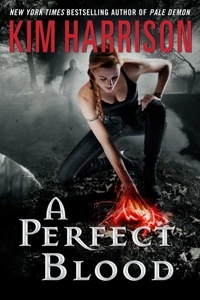
I just finished reading “A Perfect Blood”. In it, Rachel Morgan has to deal with a serial killer doing ritualistic slayings who’s origins look demonic.

I admit I am rather bias. I love Kim Harrison novels. The magic, the mayhem, the witches and vampires… Yes, one of my favorite series.

Times have changed. Authors can, if they choose, be very interactive with their fans. Kim Harrison answers her fans on her Facebook page often, giving insights into her books. There is a character in “A Perfect Blood” which isn’t exactly introduced. So, natural, I went to the internet to find out where this character came from. The answer was on Ms. Harrison’s Facebook page. Another fan had asked her the same question, and Ms. Harrison gave her the name, and a brief description of where the character was introduced (in a short story in a separate book) but didn’t ruin the story for anyone.

More authors are choosing to stay in closer contact with their fans. Not just about their books, either. They share things just like anyone else. Pictures, news, updates on their personal life. These authors, those who “get a little personal” seem to do very well with their books too. They’ve made a connection with their audience.

After all…. if you actually like the person who’s writing you may feel even better about throwing some money their way to read their work.

What’s the Point of it All?

What’s the point of telling a good story? Why do it?

There have been story tellers for centuries. Sometimes called mistrals or bards, other times wise old men. They would sit in crowded, smoky bars, or on dusty streets and weave stories into tales, or song for the few coins dropped in their palm. Actors would strut and fret their way across stages. Criers would call the news out to the milling throngs.

Story telling is in our blood.

Our story tellers, in this particular century, take on many forms. News paper journalists. Bloggers. Vloggers. Book authors. Music writers. TV writers. Game designers. Movie makers. D&D players. LARPers… I’m sure I’ve left something out.

What’s the point of it all?

It’s a way of passing on our thoughts. Our hopes. Our dreams. Our reality. A way of sharing the little pocket of the universe with others around us.

Sometimes it is our way of experiencing something we could not otherwise experience, like dragons, or storming Normandy during D-day, or even flying like a bird.

But a good story… a good story will make you immortal. Like Shakespeare, or Homer. A good story will stretch over time and space and engulf everyone it touches. A truly GREAT story will be rewritten, re-imagined, reworked, and re-read for countless years to come.

We tell stories because we are creative and imaginative creatures. And we must.

I have a lot of articles and want to make a book, can I?

Recently someone asked if it was possible to compile all of their articles together and make one ebook for sale on amazon. The biggest problem with this is that most people looking for a non-fic book are looking for something specific to one subject. The few exceptions are things like “Chicken Soup for the Soul”, but they are all “uplifting” stories, or “amazing facts” style books, and thus have a running theme.

So if you find yourself in that position here are some tips to help you make it into a single book.

First, ask yourself if you are trying to put random articles together, are they relevant to one another? Because if they are not then it is probable that you will have a better chance marketing them as individuals to magazines for reprint.

Look for themes. Health and wellness. Colonizing space. Agriculture. Uplifting stories. Children. Wedding.

You can take 4 or 5 articles with a similar subject and rewrite them into a non-fic book on that subject. Then drum up readers by having your book linked from your main page of articles.

So find a way for them to work together, a common theme, or subject, and make it into a book, not just random pieces put together.

Scivener

I have been taking the last week or so to convert all of my novels to Scrivener. It’s been a learning experience.

First, let me explain something. I don’t have one file for each novel. If that were the case of things would have been so much easier.

No, the novel I was working on today had nine separate files. The nine files happened over the years as I switched from Lotus, to Word, to RTF, and between three or four different PC’s. Each file had different parts. Two of them had nearly the whole thing, but each was missing some part.

I finally figured out the fastest way to compile these into one file was to open nine subsections in Scrivener, and paste each file in a separate section. Then I compared and compiled the sections together until I had each unique section, and could separate everything into chapters.

It was time consuming, but worth it. I am sure that I missed some minor things, or basic edits that I will have to redo, but all in all the time spent doing this was worth it.

Next I will have to compile this into one file so that I have a back up. But a single backup is much easier to handle then nine.