My Traditional Publisher Wish List

Today, on Reddit, someone said they were starting up a small publishing company, and wanted to hear from authors about what they would like to see in a publisher that would make them sign.

Here was my wish list:

As a self publisher I have to do everything myself or hire some one to edit, do cover designs, format, market, publicize, upload to all the stores, etc. Etc. Etc.

In exchange Amazon gives me 70% of every sale. They also give me data of every sale. Everyday. Online at the touch of a button. I get to set my own prices. And they offer me some plans for putting out free books, print books, audio, and translations (which I have to pay for, of course).

What I would want from a publisher, if I signed with one, would be all of that stuff (uploading, formating, editing, cover design, marketing, sales, etc) to be taken care of in exchange for giving up more of my royalties. I would also want higher royalties on ebooks then on print books. At least 50%. I know what I get for ebooks on amazon, and I know how much work goes into it after the initial set up (next to none), so I would expect for that to be taken into account. I also know publishers offset their overhead through ebook sales, so I would be willing to give up some, but not all, of my 70%.

I would also want transparency. An easy to read invoice showing how many books were sold, how many returned, prices, etc. Monthly online statements, and quarterly payments, monthly if possible. Direct deposit would also be helpful.

Also, I’d want a limited time contract. 5 years sounds about right unless renegotiated. That way if your not making money on it and you abandon it, then I still have a chance to use it for something.

I do not ever want to sign anything that says exclusive. Not for all my books, not for a genre, and not even for a series. They are my books, and I have to make the right choices for them book by book. But then again, if you’re doing a great job of selling and caring for my books, then of course I’ll come back to you.

And lastly, I want some clear sense of marketing. What are you doing for me that I can’t do, or hire out, for myself? What makes giving up my royalties worth while?

Around the Web

sprtLast night we had a very special episode of SPRT, where we talked with Hugh Howey (author of Wool) about his new website, AuthorEarnings.com

If you don’t know what any of this is… go listen to the first 15 minutes of the show that will catch you up nicely. If you are interested then just stick around and listen to the rest of it. We ended up recording for two hours, something we’ve never done before, because the subject was so interesting, and Hugh is such an awesome guy.

Also, you might be interested to read Chuck Wendig’s thoughts on it, or Dana Beth Weinberg’s. There have been some others, but those are the two I found right off hand.

Now… back to the regularly scheduled shenanigans.

Niel Gaiman reads “Green Eggs and Ham“. Enough said.

How to Craft Tweetable Quotes That Spread Your Content like Wildfire

Hugh Howey reads his introduction to “From the Indie Side” about what it means to be an indie author.

Random Penguin India recalls, and will destroy, “The Hindus”,, an alternative history book, because a Hindu educational organization sued them over it.

Amazon releases “150 Love Stories for Every Romantic Mood”. I don’t see ‘bitter’ or ‘single’ on that list.

That’s all for now. I am going to try to make this a regular weekly thing again, as I really enjoy it. I was also thinking of doing it as a vlog…. would anyone be interested in watching a vlog with me about odd things I find online?

Are You an Elitist?

I read Jim C Hines post today in which he states “it isn’t an us vs them thing” (regarding self publishing verses traditional publishing).

I found the post through Reddit, and I agreed with it. As I commented on the post, Self Publishing is about giving authors options. The more options you have, the better decision you can make.

So I went into the comments on Reddit, and what did I find? Several would be authors saying how much better traditional publishing is. (Not a single one of them, from what I can tell, were published in any way.)

Sigh. You guys… you missed the point.

Not to say that self publishing doesn’t have it’s fair share of elitists. This thread was just filled with traditional publishing elitists.
“Self publishing is for people in a hurry to get published”… well, yes.
“Self publishing is full of rank amateurs.” Sure. So it everything else.
“SP is all drivel…” No. Just, no.

The route of self publishing isn’t better, or worse. It is what you make of it. How much time and effort you put in. How much insight you want to share. Or just plain fun.

It is an option that, by it’s very existence, gives authors avenues they did not have just ten years ago. It gives them the ability to stand up to a publisher and say “this contract isn’t good enough, I’ll do it myself.”

Now, is it right for everyone? Of course not. But that is up to the author to decide, not the mass of people on some shitty forum that can’t get their head out of their ass.

(Too far?)

Seriously, people. We have enough entitled elitists making rules for other people to live by. Just stop it. We defeated the gate keepers. We have open access to the world. But that doesn’t entitle us to be dicks about it.

“Don’t be a dick.” Wheaton’s law. Learn it. Live it. Good!

Why does net neutrality matter?

There are certain things a person, or any animal, needs to survive. Food, water, and shelter. A place to call home.

In the same respect, an economy, and a country, has things that it also needs to survive, and even thrive. Those things change over time as technology and the world evolves, but they are necessary just the same.

Before the invention of the telephone, people, and corporations, were limited in their ability to expand. They had to wait for correspondence through the mail, or short telegraphs. Or, travel, which at the time could take months to cross the ocean. Everything moved slower out of necessity.

After the invention of the telephone there was a period of adjustment. People understood the significance, but control of the phone and the lines involved, were regulated by one company, Bell. They, along with the help of the FCC, made it difficult to expand the network. Devices that were the precursors to faxes and modems were not allowed to be connected to the lines until the courts forced them to allow it. Bell wanted every device to be made and rented to consumers by them.

In 1974 the US Department of Justice filed an anti trust lawsuit against AT&T. It wasn’t until 1985 that they agreed to a settlement and broke up the monopoly.

They realized that the monopolistic tendency of Ma’Bell to suck every cent they could out of the industry was stiffling innovation, and technological advancement.

Now we have a similar situation. Companies and individuals depend on the internet for sales, marketing, communication, and entertainment. We get most of our content online. Indie creators have used services like KDP and youtube to promote and expand their reach.

All of this has been made possible because of “Net Neutrality”. Something a court ruling just overturned, and we no longer have.

Net Neutrality means that the internet provider is providing a service. Like a water company provides water. You can do whatever you want with the water, connect as many hoses as you like. Boil it, fill a pool. Freeze it and make an igloo. It doesn’t matter. You are just buying a service.

But internet providers are closely linked with cable companies, which means the increase of streaming services like Netflix and Hulu is a decrease in cable. Companies like Comcast and Verizon have been fighting for the right to charge users more to use these streaming services, thus making their $70 a month cable bill look more appealing.

This time it isn’t the FCC that is holding up the monopoly. It was a supreme court judge that said net neutrality wasn’t necessary because if you didn’t like your service you could just go to a different company. He failed to recognize the fact that many people do not have a choice in service providers, and even when they do the companies often work together to keep prices high. Only Google Fiber has given any real compatition

But don’t think this will stop with cable and netflix. Indie music, books, and cames also give competition to established corporations, and they will be looking for ways to use this to their advantage. What happens if youtube, or amazon get slowed down, or even blocked to make other publishers happy?

We simply don’t know how this is going to effect us, but one thing has always proven itself to be true: as long as monopolies hold onto the old ways innovation will be difficult, slow, or even non existent.

What can you do? Sign this petition. Spread the word. Send a letter to your congressmen, and the FCC. Email your representative. CALL THEM. Make some noise.

This is incredibly important. We are thriving because we have access to this marvelous technology. Don’t let them destroy it.

Who deserves the money?

A few days ago, Jim C Hines released his yearly statement on pay from traditional publishers. In response, Michael J Sullivan made this statement:

I really applaud Jim’s commitment with sharing income information. Back when I was unpublished I remember getting incredibly depressed after seeing his posts and the survey done by Tobias Buckell[1] about income and science fiction/fantasy writing.

I think it is important for people to understand just what the economic realities of this business are…

Nowadays I have a bit of a different perspective…I’m angry. Angry that someone like Jim could sell not one, not two, but three novels in a single year and still make, why I consider to be an incredibly small amount of money for the amount of work required to do so.

I’m angry he has to fit his writing around a day job. I’m angry that after 18 years and nine novels with one of the major imprints he’s made $33,598.19 last year and $60,800.

That’s just a part of what he had to say, and I admit, I agree with him. The major reason I don’t plan to go back to traditional publishing is the fact tat the royalties suck. A lot of the time you get an advancement, and never actually earn out for one reason or another, so you never get another dime. Plus you can’t go to Amazon, or B&N and see how many books you sold. You have no control over price, or sales. And if you want your rights back… well that’s not happening either.

But, I think placing all his anger on the publishing company is out of place.

How long have we had self publishing available? 70% royalties from Amazon, and we get to see everything. We have complete transparency, and ability to adjust everything the way we like. Not only that, but it’s been proven that you can make money that way. That you can gain fans, and become a best seller. That it is possible to do well, and that a hybrid model (publishing books in both traditional and self publishing) is the most effective way of getting your name out there, and getting paid.

And Mr. Hines doesn’t bother with self publishing.

To expect traditional publishing to change very quickly, after it’s been growing in momentum for the last few hundred years, is unreasonable. It’s like a train barreling down the tracks at high speed. It has a lot of weight behind it, and it is going to take a lot of force to stop it.

We, indie publishers, have added a lot of force to at least get them to change direction a little bit. They are bringing down some prices. They are starting to offer better deals to some of their writers, like letting them keep ebook rights. But it’s going to take a while to figure out the balance between traditional publishing and self publishing.

Ultimately, the power is in the hands of the authors. We can choose to go traditional, or we can choose to self publish. We have to weigh the cost and benefits for ourselves. Being angry at the traditional publishers for their lousy deals is like being mad at a train that won’t stop on a dime. They have only as much reason to change as we give them.

I’d also like to say we will probably be discussing this on The Self Publishing Round Table this Thursday at , so if you are looking for an interesting discussion of this, and other relevant topics, you should check that out this week.

Around the Web

I stopped doing “Around the Web” segments on my blog because I started doing the “Self-Publishing Round Table”. Once we started focusing on writer related news it no longer made sense to also do a blog post.

But, I then stopped linking the show to my blog. I shouldn’t have stopped.

On that note… if you’d like to see the video you can get it here, on youtube. The video is also available to watch, along with the community commentary, on our podcast website.

If you’re only interested in the news, here are the links we talked about this week. 

 Tom Clancy died on Tuesday…

New global online bookseller that has ships worldwide, and has free shipping.

 Random Penguin says it’s still about the books…

Jeff Bezos shows shows off a new video tech support. (Kindle Fire)

The Alliance of Independent Authors warns about publishers using unscrupulous practices. (again!)

 Author pleads for readers to buy his books direct from publisher, not Amazon.

How KDP select might still work in some circumstances.

Why char-langs are so interesting, and fans LOVE them. (video)

Kobo on track to be a billion dollar company. I believe that is news.

 Scribd, Harper Collins team up to be an ACTUAL Netflix of books.

A blog that tracks indie book sales/placements.


And one we missed from the actual show:

What if writing was a competition?

Writers should write!

I just read this great article by Hugh Howie over on Huffington Post. In it he talks about his advocacy for writing, and self publishing that writing. He said:
“We don’t rail against the proliferation of YouTube videos from aspiring filmmakers or DeviantArt accounts from future designers. We celebrate the act of bettering our craft by producing early works.”

This got me thinking about my own journey as an artist and writer, and the little encouragements along the way.

Drawing was easy. I started with an Elfwood account, that actually still exists. I got a DeviantArt account later, and still update it now and then. People like and comment on my art still. I sold some paintings, wrote some tutorials for wetcanvas.com, and could have continued on a path to an artists career. Not an amazing one, but a nice one.

But as much as I love art, I couldn’t make it my career. I’m good, I’m not amazing, and I don’t have the patience to practice and study to become amazing. I can’t even decide what style I like to do, so there is nothing consistent in any of it.

But writing…

I posted my first chapters/short stories to Elfwood. That was my first taste of reader feedback. Again, some of it still exists, and I don’t plan to take it down.

Then I switched to writing.com. An interesting platform, with some nice features. I had a few readers, but I couldn’t pay for a subscription so the limit of five stories up wasn’t enough. I did delete my account there.

I had my own websites. Several, in fact. Getting people to go to your website is a pain in the ass. I loved building them, but then I’d take them down a few months later.

The first time I actually got money for something I wrote was when I joined redpaper.com. It was the first micro-transaction community, and I really loved it. I won a contest and made ten bucks there once. Sold some comics, some desktop pictures, and a few articles and stories. It wasn’t a lot of money, but it was incredible to actually get money, even less then a dollar, for the things I wrote.

This was a form of self publishing, and I didn’t even realize it at the time. It encouraged me to produce more things all the time. I don’t care that I got so little… it was mine! I earned it. It felt amazing.

Later, I switched to magazines… I was suppose to earn $20 per article/story they published. It didn’t work that way. I ended up getting nothing, which cut my confidence in publishing a lot. The fact that they didn’t see fit to pay me, even though I had a signed contract saying they would, contributed to my writers block. It made it a little easier to walk away when my life got so stressed out.

Youtube, DeviantArt, and similar venues… they offer more then just places to show your work. They aren’t just brag galleries, and show pieces. They offer the chance to actually make money doing something you love. Authors should have that same opportunity.

It might not be a lot of money sometimes, but does it really matter? It’s about encouraging an artist of any kind to get better at their craft. And if I can earn enough from writing to go to Starbucks once in a while, then that’s encouraging. Because it makes me believe some day I might make more. Maybe even enough to do this full time.

And that’s worth it.

FAQ- Editors

FAQ- each week I’m going to pic a frequently asked question and answer it here. You will be able to find the entire FAQ on a page soon.

This weeks question:

“I finished my novel, and now I need an editor. Is it normal to get an editor lined up, and for them to take weeks, or months, to get back to me?” (paraphrased)

No, that isn’t normal. An editor should get back to you within the week unless they tell you they are going on hiatus for a while. But perhaps you are too swift to choose your editor.

Every editor I’ve worked with I’ve asked them to do a sample edit. They usually get 2000 words, go through it, and see what it’s like. That way they know if they want to work with you, and you know if you like the way they work/edit. That includes how fast they answer emails, how they respond to your work, etc.

Not every editor is going to fit your work. Some are terrible at it, but claim they are editors anyway. Others won’t like your style or subject matter. Some will just be over booked and unable to give you any help, but may not want to brush you off right away.

My advice… go find a few editors. There are several places you can look. Elance, Predators and Editors, or just Google “editor service”. Even amazon has a relatively cheep editing service for .012 cents a word through Createspace.

Do some homework on the editor you are trying to get, and **get a sample**. Most will not charge much, if anything, to do the sample. Check them out on Facebook, G+, and Twitter to see if they get any good/bad reviews through social media.

Most will ask for half up front, the rest when finished. If they ask for all of it up front then RUN! Price, in my research, has been 2 cents a word, so for 79k words that’s about $1500.

It may also be helpful to get a few people to read your manuscript before sending it to an editor. Beta-readers help you iron out the roughest bits before an actual editor gets a hold of it. Always a good idea.

Good luck.

Around the Web

The last few week’s I’ve been rather obsessed with trying to finished “Forgotten One”, not just the writing and editing, but the cover (which I hate so far) and everything else that goes with it. The only thing I have “finished” at the moment is the blurb that goes in the description field. Even that needs a slight tweak.

So, to take a break from wracking my brains over this, here is another installment of “Around the Web”.
In no particular order.

Infograph, Self Pub vs. Vanity Pub vs. Traditional Pub

Why one author turned down a publishing deal from Amazon (and from her blog, more)

25 Steps to Being a Traditionally Published Author (which is quite funny, and has the same steps as a self pub from 1-9, then there are a lot fewer steps [editing, formatting, publishing, marketing] but equally as hard.)

10 places to get reviews on your book.

Balancing Work and Writing

25 Editing Tips.

Around the Web

And I need to do another “Around the Web” post, because I have a few interesting links to share, and i don’t want to forget.

Smashwords is allowing “pre-orders” of books published through them to any platform.

KDP select is adding support for Japanese, and a couple other changes.

4 real inventions inspired by SF, a video from SciShow.

Garrett Robinson put up a fantastic formatting tutorial for print and ebooks. (there are several on his website.)

Templates for all the headers, avatars, icons and backgrounds on social media.

A great example on world building with map making.

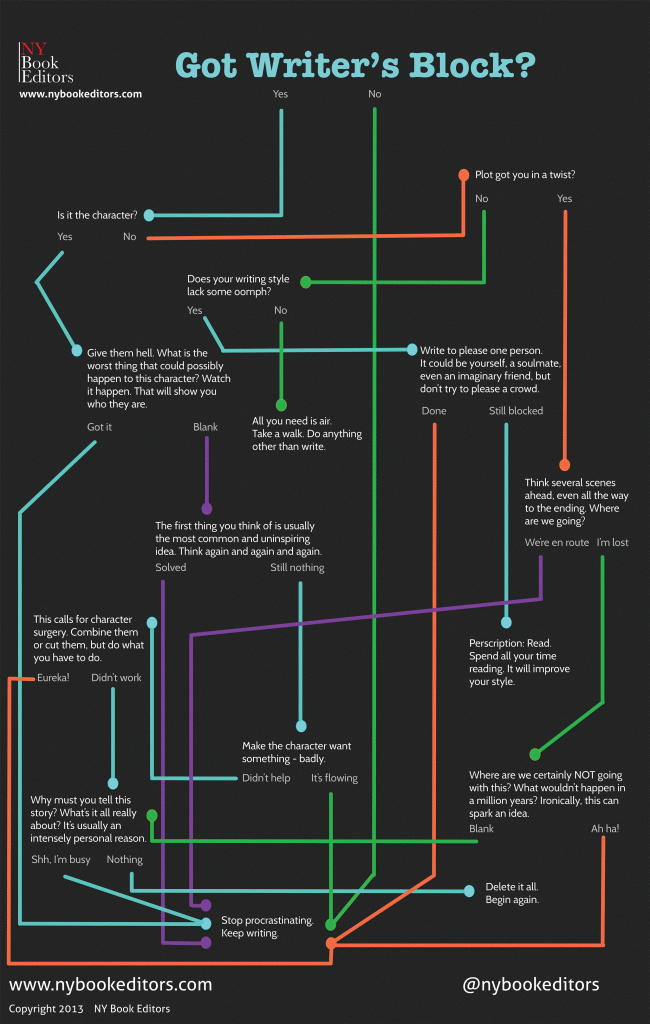
A flow chart on how to break free of writers block.

Cliche Book Covers… Don’t do these, seriously.

Watch Neil Gaiman read his book, The Graveyard Book

Neil Gaiman discusses being disappointed by books (writing or reading them.)

The Round Table Podcast is back with an episode about “The ‘Death’ of Cyberpunk”

Joanna Penn shares her experience taking a traditionally published book back to self publishing.