Homonyms

Spelling. It’s been a struggle for as long as I can remember. And homonyms just make it so much worse.

Then vs Than

Site vs Sight

Effect vs Affect

And, of course: Your vs You’re

That last one I rarely mess up on because every single time I write it I say to myself “you are” to see if it fits. It’s annoying, but useful habit and nets fewer instances of grammar nazi’s attacking me on forums.

I honestly wish they would drop “than” and “affect” from the written language. If you’re talking you can tell the difference just by context. If you are reading it is the same. Having the different spelling just makes it complicated, and makes my editing take another day just hunting down every single last instance of “then” so I can double check… is this related to time, or comparing something? Can I just remove that word all together?

English, with its many homonyms and unwieldy phrases, is a horrible spellers worst nightmare. And yet… I chose to write.

I must enjoy pain.

Around the Web

A lot of things going on since the last time I posted one of these. A few articles, and several videos.

Jessica Blair, Author of 22 romance novels, is actually 89 year old war vet, Bill (Proof that pen names to hide your sex works both ways.)

Why the US internet is so slow and expensive (Vimeo)  (YouTube) This is important to anyone in the US. For writers and creative types who do a great volume of work online, it matters.

6 Publishing trends that will benefit readers and writers.

148 audio podcasts from Joanna Penn

4 ways to amplify your creativity.

Making your fantasy world more relate-able.

Secret anatomy of KDP select

Google+ communities for writers (Youtube) from Books and Beer

Ira Glass on Storytelling (Vimeo) (YouTube) (I might have posted this before, but I love it.)

Maybe I can do this

A while ago I posted this image of my “writing list”. It was overwhelming, to say the least. But I think I tamed the beast. After going through the list, the ideas, and the half formed plots I whittled it down to those that I actually had a fair amount of progress on, a fully functional plot, and an interesting story idea. And this is what was left over:

image

The ones on the left in yellow and orange are novels. Everything else is a short story, and the ones in the middle, in faded grey, are in the “to write after everything else is finished” category. Best part? See all those orange spots? Those are FINISHED! They are mostly first drafts that are complete and waiting an edit from me before I send it to an actual editor for the final edit before publishing. But… they are finished. So what does this mean?

This is me saying: I can do this. It isn’t as overwhelming as I was telling myself. And, when I am done with these, there are more stories in the well to draw from. I’m actually a little excited!

About word counts

I spoke a little about word counts yesterday, and how writing every day is part of the secret to success.

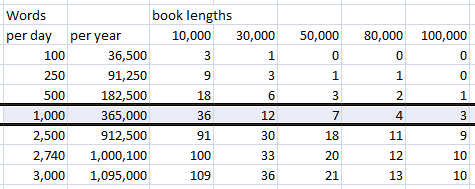
Here is a visual to go with it:

wordcounts


They say the “sweet spot” is 1000 words a day. If you can manage that you would actually write over 300k words every year. That is three full length, 100 THOUSAND word length books…. a year!

And most “books” aren’t 100k anymore. They are generally the 50-80 thousand word variety. that is 4-7 full length books. In a year!

If that doesn’t get you to write well…. What will?

I am at 250 a day right now. That’s averaged, not every day. But I’m working those writing muscles till I can get to that 1000 a day sweet spot.

What is your writing goal?

How to be a Success

I was having a conversation on Twitter last month about making writing your day job, and I sent this to the guys over at SPP:

I thought I’d expand upon this “simple” idea, because out of all the writing books, blogs, articles, websites, podcasts, and videos, everything distills down into these four points.

1. Write Well.

“Well” seems to be such a simple word. But it includes a lot of things. Grammar, spelling, characters, plot, and everything else involved with a story. It also involves knowing the difference between a workable story, and something that you should just let go.

You can always get help with the mechanics of a story. Workshops abound. Editors are for hire. You can even hire a ghost writer to write up the idea/plot/storyline you came up with and stick your name on it (not generally recommended.)

If you have a compelling story, with characters your readers care about, then you are headed in the right direction.

2. Write a lot.

Be PROLIFIC! I can not stress this enough. I don’t care if you are writing in your journal every day, but the fact remains the more you write, the more you will write. However, you shouldn’t JUST write things in your diary. Practice writing short stories, articles, blog posts, and anything else. Write as though you are writing to someone, expecting someone to read it.

Writing also helps you improve your ability to write. Grammar and spelling, as well as just coherence. This goes for reading as well. If you don’t read, or hate reading, then how can you write well?

3. Publish often.

Some of the best selling authors are there simply because they write a lot of books. The more books they write, the better visibility they have. The better chance someone has to see something they wrote that was great. 

Here is a list of some prolific authors, many of which are well known.
4. Engage readers.

Email lists. Blogs. Fan mail. Twitter. Facebook. Websites… really it doesn’t matter how you engage your readers, but the internet makes it incredible easy to do just that. If you don’t do so, or come off as a grumpy old guy/gal who doesn’t give a half a penny for their fans then it is less likely you will grow your reading ranks.

Look, we live in a connected world. I actively talk to some of my favorite writers now. I send them tweets, or comment on their Facebook status, and they answer me. It’s awesome. I love the fact that they know their fans are their bread and butter, and they love interacting with me, and all the other people who love their work.

Kim Harrison got feedback for, and changed the cover for one of her new books. Sean Platt and David Write added three chapters to the end of their series to clarify their writing. Piers Anthony has answered every single fan letter he could, and even included characters, puns, and small plot lines to really engage his readers.

Will all of this get you tons of fans? Ultimately only time can tell, but these four things will get you closer then any one of them by itself.

Character Creation

I wrote this tutorial on character creation a LONG time ago. (2001 I think). It’s been up on Elfwood ever since, so I thought I should share it here. Periodically I get comments from others about how it helped them flesh out their characters.

A person is not only a personality. They are experiences, hopes, joys, passions, and foibles all rolled into one little package. For a writer, you must not only create these in yourself, but for several, if not hundreds of other people as well. Those with the fullest detail, I have found, are actually far easier to write about then those who I know nothing about.

This list helped me keep significant details about certain characters strait when I was working on very long pieces. It also helped when I first started writing to really grasp character development in general.

Continue reading

Misconceptions

I find it incredibly frustrating when I finish something, and then figure out it wasn’t finished after all.

There it is, laid out in all it’s wordy glory. There is a complete plot, a few fully fleshed characters, and a wonderful vista for their story to take place.

Putting “the end” on a manuscript is so wonderful. Knowing it’s finally finished, edited, and complete.

Then you send it to be read and when you get the comments you realize… it isn’t finished at all.

Such a terrible feeling. But all you can really do is pick up where you left off and polish some more.

Distractions

I’ve got so many distractions right now. Doctors, car repairs, children’s homework, and my own head that keeps running away with worries and possibilities.

One of my biggest distractions? That huge stack of story ideas that I want to finish. Each one wants to be completed, and I don’t have enough time or the mental energy to write all of them right now.

Eventually… over time… I am sure I could finish them all.

But what about “Plants vrs Zombies”? Or “Skyrim”? Or bubble baths with good books? S’mores by the fire? Come on! I NEED these things… right?

All of these distractions piling up, and my stories are forgotten on their little flash drive.

Pick one. Write. Edit. Publish.
Rinse. Repeat.
Just keep swimming….

And remind myself, day after day, that if I finish this and start publishing regularly then maybe, eventually, I won’t have to have that day job anymore. Then I’ll have time for “Skyrim”, “Plants vrs Zombies”, and every episode of the “Walking Dead” that I missed. Till then…

Go Write!

What’s in a Sale Price (An open letter to Johnny B Truant)

In today’s Self Publishing Podcast Johnny B Truant said:

“A book is F*ing $3. As an artist I have a little bit of a problem with the idea that people would balk at that.”

I’ve been having a similar discussion with people regarding games. Specifically the idea that game makers, like Sony, want to curtail second hand game sales, like Gamestop, as they feel that used games are lost revenue.

Here the crux of the matter…. Even if you managed to stop every free/sale/used transaction for every single item in the entire world, producers of content still won’t make more money, for one really simple fact: we can’t all afford new.

Yes, you’re an artist. Your product is worth money. I get it, I’m a writer too. I want to earn a living off my writing as well. However, you are looking at it from the perspective of “this is my stuff, you’re getting my stuff, and you should pay me what I think it’s worth.”

Game developers also have the added incite of “this is how much it cost us to make this game, and this is how many we think we can sell this month.” So they slap a tag for $60 on it, and release it. They are absolutely right that the game is worth, from their perspective, $60 dollars.

Now, lets look at it from my perspective.

I’m a single mom of three. I love books and games. I am teaching my three children to also love books and games. I make less then $2k a month, and my bills alone suck up most of that money.

$60 is one bill. Or a car full of groceries  Or two pairs of shoes. Or two tanks of gas to get to work. Or three nice dates with my wonderful boyfriend.

So I wait till games are on sale, (got to love Steam!) or I wait till the price comes down. Two, three years after a AAA title has come out and grossed the company millions of dollars it might be available for $20 from the company. Maybe. If I’m lucky. Or I can hit a used bin and possibly find it for a little less. It still won’t be that cheap, but maybe I can finally play it.

It’s the same with books, only most of the time I have to go to the library. Sometimes, if i really love a book, or an author, I will splurge and buy their book. Maybe give it to a friend, or sell it back to Half Priced Books, more then likely just keep it on my shelf. Keep in mind I read about 50+ books a year. I can’t afford to buy all of those even if they are only $3.

Yes, you as an artist deserve to be paid for your work. I, as an upcoming author, deserve to be paid for my work. But not everyone is in the same place that you are. Not all of us are able to go out and buy every book/game we want.

I currently own over 23 of David Write and Sean Platts books. I got a lot of them for free, and then I started buying them. I joined Seans list and got this nifty little email saying “Thanks for joining, I’d like to give you a free book.” I turned it down because I already had so many of their books. I also own several Johnny B Truant books, and I bought most of them, but I did get several for free.

I try to repay in my way by giving reviews, and sharing the podcast with other writers, and by buying a few now and then when I have some extra money. But I keep a look out for sale prices of my favorite authors.

Steam is actually an incredible example of what sale prices can do. Summer sales, and winter sales on Steam can lower game prices up to as much as 75% off games, sometimes more. And what happened? Well I bought 80+ games this year. I know I’m not the only one. Steam sales more games during these sales, and they make more for the people selling games through them then any other time of the year.

When you lower the price a lot more people see it, and buy it. You make up for lower prices through volume.

Now, Steam has an amazing platform, they have sales specifically a few times a year, and a few games on sale each day. They can afford to do this, and they do it well. While books are a bit different  you shouldn’t discount the power of “free” through KDP.

TL;DR Remember that your buyers are made up of different kinds of people. We can’t all afford things at the higher prices, so giving us intensives (sales and freebies) will get us interested, and may get you future sales, reviews, and rating to drive future business. It’s about making a brand, not just making a buck.

Slightly Overwhelming

image

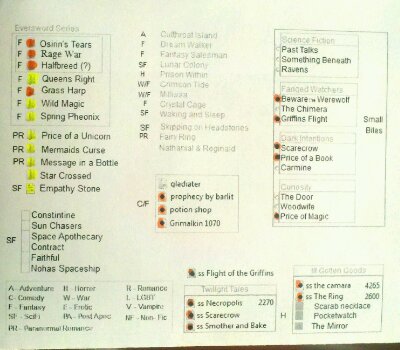
This is my story list. Or rather it is a list of every story I have started and which I think would make a good finished product. Some have as little as a page already written. A few are finished. The ones on the left are all novels with as much as 100 pages already written. This is overwhelming, to say the least. It’s why I have taken it upon myself to actually stop screwing around and WRITE. It’s what I dreamed of doing when I was growing up. It’s what I should be doing. It’s what my brain wants to do. So I say to myself: No excuses! Go write!