Around the Web

A lot of things going on since the last time I posted one of these. A few articles, and several videos.

Jessica Blair, Author of 22 romance novels, is actually 89 year old war vet, Bill (Proof that pen names to hide your sex works both ways.)

Why the US internet is so slow and expensive (Vimeo)  (YouTube) This is important to anyone in the US. For writers and creative types who do a great volume of work online, it matters.

6 Publishing trends that will benefit readers and writers.

148 audio podcasts from Joanna Penn

4 ways to amplify your creativity.

Making your fantasy world more relate-able.

Secret anatomy of KDP select

Google+ communities for writers (Youtube) from Books and Beer

Ira Glass on Storytelling (Vimeo) (YouTube) (I might have posted this before, but I love it.)

Meeting of the Pets

image

My boyfriend and I rescued a california king snake the other day and brought him home. My cat has been quite curious about him ever since.

We love Winchester. He loves to be held. Often you’ll find my boyfriend and I curled up on the couch with Winchester warming up on our necks.

Everyone talks about rescuing dogs and cats, but other pets get left behind, too. Snakes, rodents, turtles, birds and lizards among them.

These pets could be let lose, but more often then not they aren’t capable of surviving on their own. For my snake… he’s a warm weather snake, and we live in a very cold region. He’d die out there.

I’m a pretty strong believer in “spay and neuter your pets” to keep fewer of them in shelters. And not buying dogs and cats from puppy farms. There are enough lonely pets that need love in the world already, not to mention genetic problems due to over/in-breeding.

Anyway, I didn’t exactly mean to be preachy today, just wanted to share my wonderful new pet with everyone.

Maybe I can do this

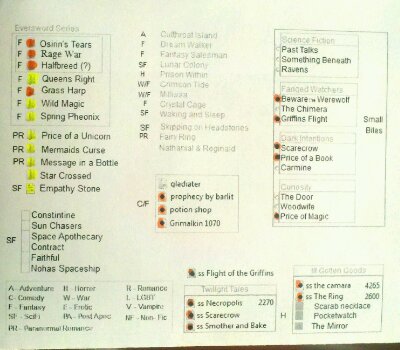
A while ago I posted this image of my “writing list”. It was overwhelming, to say the least. But I think I tamed the beast. After going through the list, the ideas, and the half formed plots I whittled it down to those that I actually had a fair amount of progress on, a fully functional plot, and an interesting story idea. And this is what was left over:

image

The ones on the left in yellow and orange are novels. Everything else is a short story, and the ones in the middle, in faded grey, are in the “to write after everything else is finished” category. Best part? See all those orange spots? Those are FINISHED! They are mostly first drafts that are complete and waiting an edit from me before I send it to an actual editor for the final edit before publishing. But… they are finished. So what does this mean?

This is me saying: I can do this. It isn’t as overwhelming as I was telling myself. And, when I am done with these, there are more stories in the well to draw from. I’m actually a little excited!

About word counts

I spoke a little about word counts yesterday, and how writing every day is part of the secret to success.

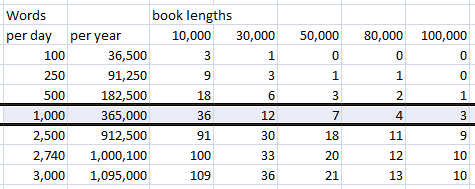
Here is a visual to go with it:

wordcounts


They say the “sweet spot” is 1000 words a day. If you can manage that you would actually write over 300k words every year. That is three full length, 100 THOUSAND word length books…. a year!

And most “books” aren’t 100k anymore. They are generally the 50-80 thousand word variety. that is 4-7 full length books. In a year!

If that doesn’t get you to write well…. What will?

I am at 250 a day right now. That’s averaged, not every day. But I’m working those writing muscles till I can get to that 1000 a day sweet spot.

What is your writing goal?

How to be a Success

I was having a conversation on Twitter last month about making writing your day job, and I sent this to the guys over at SPP:

I thought I’d expand upon this “simple” idea, because out of all the writing books, blogs, articles, websites, podcasts, and videos, everything distills down into these four points.

1. Write Well.

“Well” seems to be such a simple word. But it includes a lot of things. Grammar, spelling, characters, plot, and everything else involved with a story. It also involves knowing the difference between a workable story, and something that you should just let go.

You can always get help with the mechanics of a story. Workshops abound. Editors are for hire. You can even hire a ghost writer to write up the idea/plot/storyline you came up with and stick your name on it (not generally recommended.)

If you have a compelling story, with characters your readers care about, then you are headed in the right direction.

2. Write a lot.

Be PROLIFIC! I can not stress this enough. I don’t care if you are writing in your journal every day, but the fact remains the more you write, the more you will write. However, you shouldn’t JUST write things in your diary. Practice writing short stories, articles, blog posts, and anything else. Write as though you are writing to someone, expecting someone to read it.

Writing also helps you improve your ability to write. Grammar and spelling, as well as just coherence. This goes for reading as well. If you don’t read, or hate reading, then how can you write well?

3. Publish often.

Some of the best selling authors are there simply because they write a lot of books. The more books they write, the better visibility they have. The better chance someone has to see something they wrote that was great. 

Here is a list of some prolific authors, many of which are well known.
4. Engage readers.

Email lists. Blogs. Fan mail. Twitter. Facebook. Websites… really it doesn’t matter how you engage your readers, but the internet makes it incredible easy to do just that. If you don’t do so, or come off as a grumpy old guy/gal who doesn’t give a half a penny for their fans then it is less likely you will grow your reading ranks.

Look, we live in a connected world. I actively talk to some of my favorite writers now. I send them tweets, or comment on their Facebook status, and they answer me. It’s awesome. I love the fact that they know their fans are their bread and butter, and they love interacting with me, and all the other people who love their work.

Kim Harrison got feedback for, and changed the cover for one of her new books. Sean Platt and David Write added three chapters to the end of their series to clarify their writing. Piers Anthony has answered every single fan letter he could, and even included characters, puns, and small plot lines to really engage his readers.

Will all of this get you tons of fans? Ultimately only time can tell, but these four things will get you closer then any one of them by itself.

Excuses, Excuses

You walk through the door after a hard day at work, plunk down on the couch and turn on the TV.

You deserve a break. It was a long day, your boss was an ass, and the talk at the water cooler was draining. Plus your customer got in your face over some little thing that you had no control over.

You’re home… it’s time to relax!
Right?

Over in the corner of your living room sits that thing (piano, guitar, novel, painting, etc) that you keep meaning to get to. There just aren’t enough hours in the day.
Right?

I mean, it was a HARD day. You just need a break. Anyone can understand that!

Listen, we’ve all been there. We all tell ourselves these little excuses, or give them to someone else.

I’ll get to it tomorrow. But tomorrow never comes.
I deserve some relax time. But you need it every day.
I don’t know how to do it. But you never do the research to find out how.
I’m not in the mood. But the mood never really comes.
IT’S HARD!

It’s the last one that really gets us. It isn’t even always that it is hard. Sitting down at a keyboard and plunking in a few words or sentences isn’t difficult. Children write stories all the time. They come in with excitement holding up pictures, or plucking out keys on their little piano saying “Look mommy! See what I did?”

Then something happens. We start caring what others have to say about us, or our work. We start worrying, and fretting, and labeling ourselves according to how others see us.

So we build up walls of excuses holding that thing we WISH we could do at bay, but we never really get to it.

Those who do it… those who write novels, learn to play piano, paint landscapes or sew dresses… those who indulge in their creative ideas… somewhere along the line they said “This is important to me! I am going to do this!”

My boyfriends father took up the piano later in life. Every morning or evening when he is home he goes down to the music room and practices the piano. No one tells him to. He doesn’t often play for people…. but it became important to him.

Now, this is a busy man with a lot of things going on. Meetings, work, business lunches, a wife, and kids… but he makes time for the piano because it’s important.

If it’s important, you’ll make time. Or you’ll never learn.

I’m still learning this myself. But in the end, it’s worth every moment.

Around the Web

Tor Authors give tips on writing.

Yes, Virginia, You can be a Paid Author Too (which is a bit tongue in cheek, and NSFW language.)

11 ways you can help get your favorite author noticed, some of which are new-ish.

Google+ communities create networks for authors and publishers. (I’ve been saying for a while, Google+ people! Drop Facebook! Find me here.)

7 Worst Mistakes by Indie Authors (according to Joanna Penn, taken from her own experiences.)

Writers and Depression: An Interview with Psychotherapist and Author, Philip Kenney

And because I absolutely love this site, and think more people should use these: MOO stickers and business cards.

Character Creation

I wrote this tutorial on character creation a LONG time ago. (2001 I think). It’s been up on Elfwood ever since, so I thought I should share it here. Periodically I get comments from others about how it helped them flesh out their characters.

A person is not only a personality. They are experiences, hopes, joys, passions, and foibles all rolled into one little package. For a writer, you must not only create these in yourself, but for several, if not hundreds of other people as well. Those with the fullest detail, I have found, are actually far easier to write about then those who I know nothing about.

This list helped me keep significant details about certain characters strait when I was working on very long pieces. It also helped when I first started writing to really grasp character development in general.

Continue reading

Misconceptions

I find it incredibly frustrating when I finish something, and then figure out it wasn’t finished after all.

There it is, laid out in all it’s wordy glory. There is a complete plot, a few fully fleshed characters, and a wonderful vista for their story to take place.

Putting “the end” on a manuscript is so wonderful. Knowing it’s finally finished, edited, and complete.

Then you send it to be read and when you get the comments you realize… it isn’t finished at all.

Such a terrible feeling. But all you can really do is pick up where you left off and polish some more.